Welcome to Kett - Tomorrow's Testing Today
Home » Paper Moisture Testers
Paper moisture meters give you instant, accurate moisture readings on paper, paperboard, and corrugated products on the production floor, at receiving, or in the QC lab. Whether you need to verify incoming stock, monitor a converting line, or audit finished rolls before shipment, fast moisture data helps you prevent waste, reduce downtime, and protect print quality.
From handheld spot-checks at the rewinder to real-time online monitoring on the paper machine, Kett is the only source for paper moisture instruments across every measurement method — electrical resistance, near-infrared, contact and non-contact. Built-in calibrations for common paper types get you measuring immediately, and custom calibration support means specialty products are covered too. All instruments are backed by Kett’s Total Care Warranty.
Why paper and packaging professionals choose Kett for moisture measurement.
Press the probe to the paper and read the moisture percentage in seconds. No sample prep, no drying time, no waiting. Just get immediate data for faster decisions on the production floor.
Match the sensor to the job. The grip sensor clamps single sheets with constant pressure for repeatable results. The rubber sensor handles rolls and stacks. The desktop pressure sensor tests multi-layer products and low-moisture materials with precision.
Start measuring immediately with factory calibrations for copy paper, kraft paper, liner board, and cardboard. Create and store up to 10 custom calibrations for specialty products or to match your facility's reference standards.
Readings stay accurate across a wide temperature range. The meter adjusts automatically for paper temperature, so measurements taken at the rewinder are just as reliable as those in the QC lab.
Connect to printers, data loggers, or your quality system via RS-232C, USB, or TCP/IP. Store up to 250 readings with timestamps internally, then batch-export for reporting and traceability.
Start with portable spot-checks for incoming material and QC verification. Scale up to handheld NIR scanning for process auditing and wet-streak detection. Add real-time online monitoring when you're ready for continuous process control. One manufacturer, one engineering team, every level of measurement.
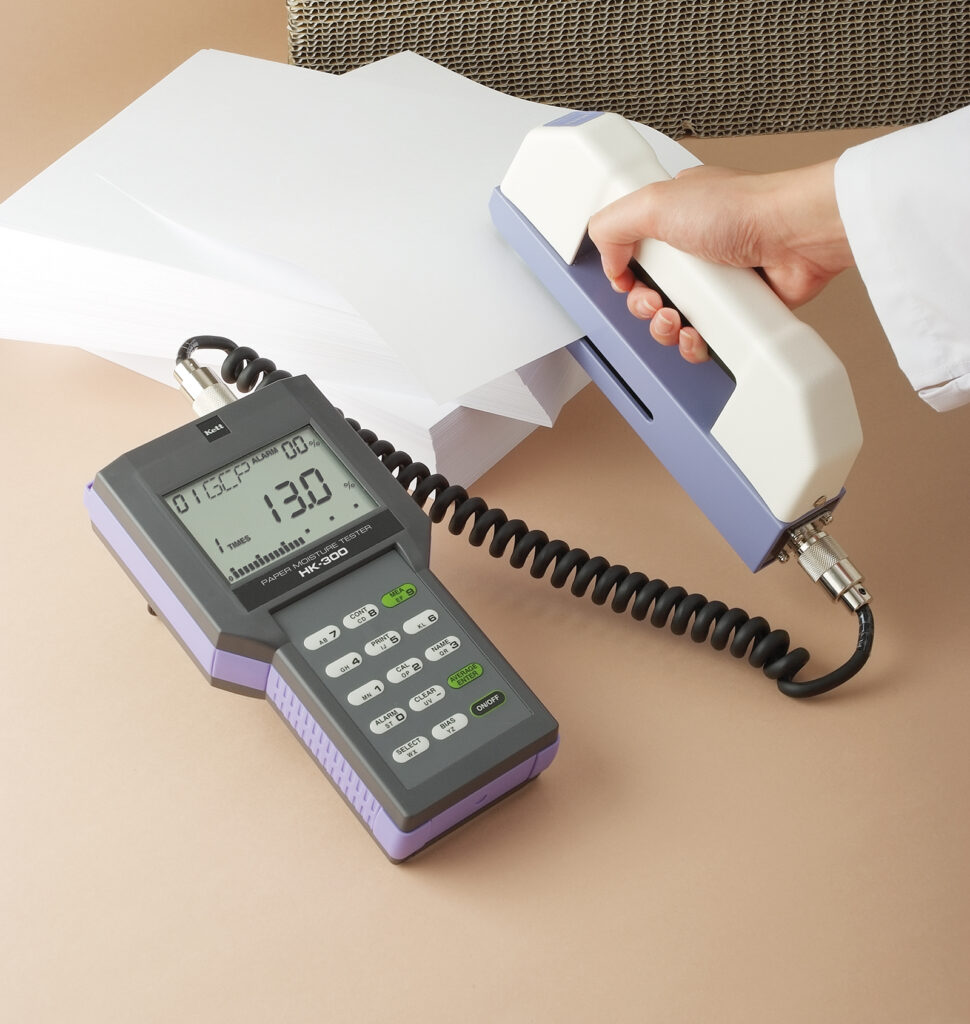
The HK-300 uses electrical resistance to measure moisture in paper products. When a sensor contacts the paper surface, the instrument sends a small, safe electrical current through the fibers. Dry paper resists electrical flow; moisture reduces that resistance. The processor converts the measured resistance into a moisture percentage and displays the result on the LCD, typically within three seconds of contact.
Three interchangeable sensors let you match the measurement method to the material. The grip sensor clamps a single sheet between two electrodes with constant pressure, minimizing operator variation and delivering highly repeatable readings on copy paper and cardboard. The conductive rubber sensor presses flat against paper rolls, stacks, and higher-moisture products — it has no thickness limit, making it ideal for liner board and kraft paper up to 25% moisture. The constant pressure sensor is a desktop fixture: you insert the paper and lower the lever to apply a controlled, consistent force, which is especially effective for multi-layer products and low-moisture materials down to 2%.
All three sensors connect to the same handheld readout unit, so you can switch between them as your testing needs change. Integrated temperature compensation adjusts readings automatically, and built-in calibration curves traceable to JIS P8127 provide a reliable reference baseline for copy paper and cardboard. Other Kett sensors are available for unique applications. We manufacture NIR instrumentation for non-contact requirements. Contact our engineers for guidance.
Paper moisture meters are used wherever paper, board, and fiber products are manufactured, converted, stored, or traded.
Moisture measurement happens at multiple stages: after the dryer section, during winding, and before rolls are wrapped for shipment. Rolls that ship out of spec lead to customer claims, downgrade pricing, and costly returns. A quick spot-check with the HK-300 confirms moisture before the roll leaves the floor.
Testing occurs at incoming liner and medium inspection, after the corrugator, and during die-cutting and finishing. Excess moisture causes board warping, washboarding, and adhesive failure — any of which can shut down a packaging line or produce rejected containers. The HK-300 with its rubber or pressure sensor verifies each layer meets spec before it reaches the converting stage.
Paper moisture is checked at the press feeder, between print stations, and in the paper storage area. Too much moisture causes misfeeds, ink absorption problems, and curl; too little causes static and cracking. Verifying incoming stock moisture before it goes on press prevents waste and reprints.
Moisture is monitored before and after coating, laminating, and embossing operations. If moisture is too high during coating, the finish blisters or delaminates; too low, and the substrate cracks during folding. Checking moisture at each stage prevents scrap and ensures a professional finished product.
Moisture testing happens after the dryer, during rewinding, and at final packaging of tissue, toweling, and nonwoven rolls. Over-dried product wastes energy and reduces yield by weight; under-dried product causes winding defects, mold risk, and customer complaints. The HK-300’s rubber sensor provides fast spot-checks on rolls and stacks without damaging the surface of soft, low-density materials.
Paperboard and cartonstock are tested at incoming inspection, after die-cutting, and before filling and sealing. Moisture in food-contact packaging can compromise barrier coatings, weaken structural integrity, and create conditions for microbial growth. These are issues which put product safety and regulatory compliance at risk. The HK-300’s custom calibration capability handles the specialty substrates common in food packaging, from coated cartonstock to molded fiber trays.
Baled fiber is tested at the buying station, at receiving, and before it enters the pulper. Moisture directly affects the price per ton. Just a few percentage points can mean thousands of dollars on a single truckload. Fast, accurate spot-checks protect both buyer and seller.
Stored paper and packaging products are tested periodically and before shipment. Paper absorbs ambient humidity over time, which can cause mold, structural softening, and dimensional changes. Routine spot-checks identify moisture gain before it becomes a quality problem.
One source for paper moisture measurement at every level — portable contact meters, handheld NIR scanners, and fixed-mount online analyzers. One engineering team supporting your entire operation.
The dedicated instrument for paper and paperboard moisture testing. Choose from three interchangeable sensors — grip, rubber, or constant pressure — to match your specific material and testing environment. Factory calibrations for copy paper, kraft, liner board, and cardboard are built in, with room for 10 custom calibrations. Digital output via RS-232C, USB, or TCP/IP connects directly to your quality system. Ideal for QC labs, production-floor spot checks, and incoming/outgoing material verification.
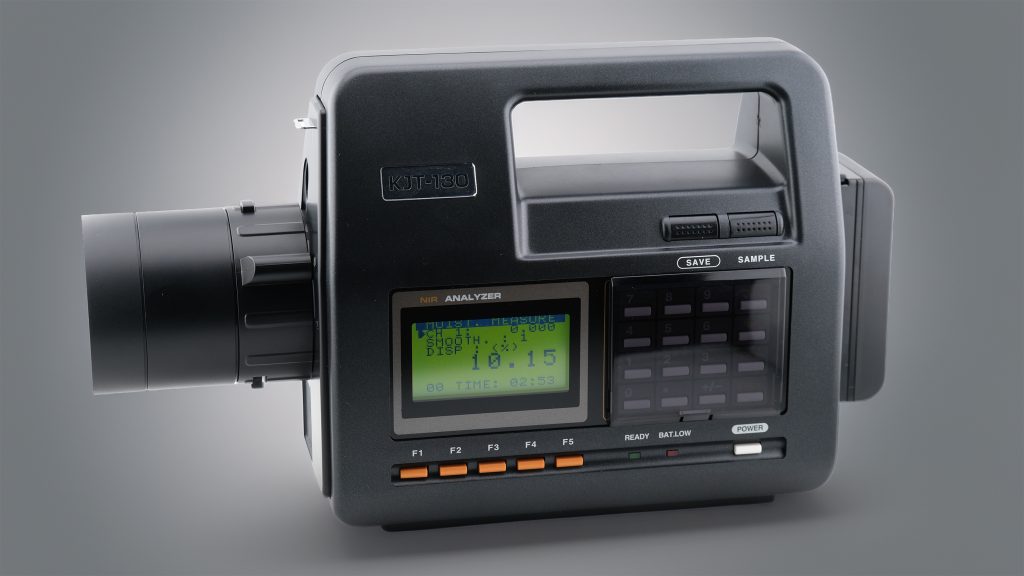
A non-contact, near-infrared handheld that measures moisture on moving paper webs and stationary samples without touching the surface. Operators use it to scan for wet streaks, verify moisture uniformity across the web, and cross-check online systems from companies like Honeywell and ABB. Resolution to 0.01% (100 ppm) and internal data storage make it a powerful field auditing tool — especially for validating or recalibrating installed process sensors.
A fixed-mount, continuous-process analyzer that simultaneously measures moisture and coat weight in real time — capabilities traditionally requiring systems costing many times more. Mounts above or below the web for non-contact measurement at full production speed. For mills and converters who need the functionality of large-frame scanning systems but at a fraction of the cost and complexity, the KJT700 delivers process data you can act on immediately.
Our engineers understand paper production from the wet end to the shipping dock. Let us help you find the right instrument for your process.