
Welcome to Kett - Tomorrow's Testing Today
Home » Whiteness Meters and Colorimeters Rice and Powders
Whiteness and purity are direct indicators of product quality, milling efficiency, and market value. Whether you are grading rice or evaluating powder consistency, an objective whiteness measurement replaces subjective visual inspection with a repeatable number your customers and trading partners can trust.
Kett whiteness meters deliver results in two seconds or less with no sample preparation. Built on decades of installed-base trust — mills, laboratories, and trading houses worldwide already calibrate against Kett values — these instruments are designed for durability, simplicity, and years of stable operation on the production floor or in the lab.
Why rice processors, laboratories, and powder manufacturers choose Kett whiteness meters for fast, objective appearance and purity testing.
Results display in two seconds or less. Rapid testing lets operators increase measurement frequency without slowing production — catch quality deviations before they become costly rejects.
Load and measure — no grinding, drying, or preprocessing. Competitive devices often require sample preparation that adds time and introduces variability. Kett meters test the material as-is, shortening the overall test cycle.
Samples remain intact after measurement and can be used for additional assays or returned to the process. This reduces material waste and allows multiple tests on the same batch.
Kett whiteness meters build on decades of worldwide adoption. The C600 continues the legacy of the C300, and the C130 succeeds the C100 — instruments recognized globally as the benchmarks for rice and powder whiteness measurement.
All-metal construction with no moving parts. Impervious to vibration and independent of instrument orientation, so they perform reliably on the production floor. Routine maintenance involves only cleaning the glass filter.
Each meter ships with a matched optical standard for drift checking. The C130 automatically notifies the operator when sensitivity adjustment is needed. The C600 offers one-click recalibration to factory specifications.
Both instruments measure whiteness using light reflectance. Blue LED light shines onto the sample surface at a controlled angle, and a photodiode detects the amount of light reflected back. Whiter samples reflect more light and register a higher value. The result is an objective whiteness number that correlates directly with product quality — for rice, this value tracks milling degree, allowing processors to optimize how much bran is removed without over-milling and sacrificing yield.
To test a sample, the operator fills a small sample cup and inserts it into the instrument. The C600 measures whole rice kernels and displays the whiteness value in under one second. The C130 accepts powders — rice flour, starch, calcium carbonate, sugar, salt, pharmaceutical powders, and cement — and delivers a reading in two seconds. Neither instrument requires sample preparation, warm-up takes approximately 20 seconds from power-on, and both include RS-232C output for connection to an optional thermal printer or PC for documentation.
Whiteness meters support quality control wherever the appearance of rice or powder products affects grade, value, or regulatory compliance.
Whiteness measurement at the polisher and grader stages helps millers optimize bran removal — enough to meet appearance standards without over-milling and losing weight. Monitoring whiteness at each pass lets operators balance yield against grade, reducing rework and maximizing the value of every harvest. Kett whiteness meters provide the fast, repeatable readings millers need to keep production on target.
Rice buyers, exporters, and government inspectors use whiteness values to verify grade and settle pricing disputes. An objective number removes subjectivity from appearance assessment — critical when trading partners speak different languages or operate under different grading standards. Kett meters deliver a universally recognized value that supports fair, transparent transactions.
Whiteness indicates the purity and refinement of flour, starch, and tapioca products. Variations in raw material quality, milling intensity, or blending ratios all show up in the whiteness reading. Measuring at receiving and after processing helps QC teams catch off-spec batches before they reach packaging. Kett powder whiteness meters require no sample preparation, keeping pace with production.
Excipient powders, binders, and fillers must meet strict color specifications for batch consistency and regulatory compliance. Whiteness measurement provides a fast check that incoming materials and finished blends meet the required standard. Kett meters document results via printer or PC output for traceability records.
Cement, calcium carbonate, gypsum, and mineral powders are graded partly on brightness. Whiteness testing at receiving and before shipment confirms that raw materials and finished products meet customer specifications. Kett meters handle the dusty, vibration-prone conditions of a materials plant with no moving parts and durable all-metal construction.
R&D teams and QC labs use whiteness measurement for product development, blend optimization, and supplier qualification. The C130 supports nine user-programmable calibrations, allowing researchers to create application-specific scales for specialized powders. Both instruments output data via RS-232C for integration with laboratory information systems.
Sugars, salts, dairy powders, and seasonings are judged by appearance before they ever reach a formulation. Whiteness variation between batches can signal contamination, incomplete refining, or storage degradation. Measuring whiteness at receiving and after processing helps QC teams confirm visual consistency before packaging. Kett powder whiteness meters deliver results in seconds with no sample preparation.
Talc, mineral powders, and pigment bases must meet tight color specifications to ensure consistent product appearance across production runs. A whiteness shift in raw material can alter the shade of a finished foundation, sunscreen, or body powder. Testing incoming materials against an established whiteness standard catches supplier variation before it reaches the blending line. The C130’s nine programmable calibrations allow cosmetic manufacturers to create application-specific measurement scales.
Two specialized whiteness meters — one for whole rice kernels, one for powders. Each instrument builds on decades of Kett’s installed-base standard. View all products in this category for the full lineup including accessories.
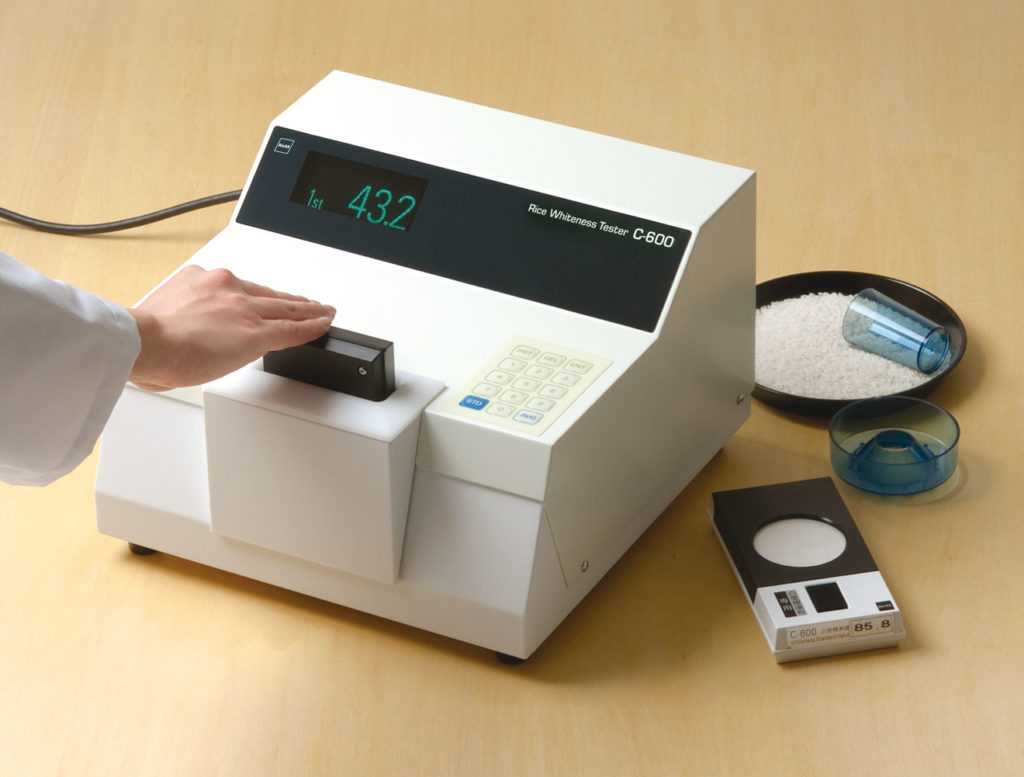
The industry-standard instrument for whole rice kernel whiteness measurement. The C600 replaces the globally recognized C300, delivering faster results in a lighter, more compact design.
Fill the sample case with rice, insert it, and the whiteness value displays in under one second.
Includes a fixed-quantity shooter for consistent sample loading and one-click sensitivity adjustment with the included optical standard.
Measures polished, brown, and pre-washed rice — both glutinous and non-glutinous varieties.
The go-to instrument for instant whiteness measurement of powders and flakes. The C130 succeeds the worldwide-standard C100 with half the footprint, 59% lower power consumption, and a 59% reduction in required sample size.
Pack the sample cup, slide the tray in, and the reading appears in two seconds — no sample preparation needed.
Ships with one factory calibration (starch) plus nine user-programmable channels for specialized materials like flour, salt, sugar, pharmaceutical powders, and cement. Integrated temperature compensation allows testing at any stage of the process.
Not sure which whiteness meter fits your application? Email or call and we’ll be happy to assist with your unique requirements.
Our engineers can help you select the right meter for your application and walk you through sample testing.